One place to govern AI.
One place to see what it costs.
Today, AI policy lives in a dozen admin consoles and cost arrives in a dozen invoices. Codiedev gives leadership a single control point and a single view across every model, harness, MCP connector and agent your teams use.
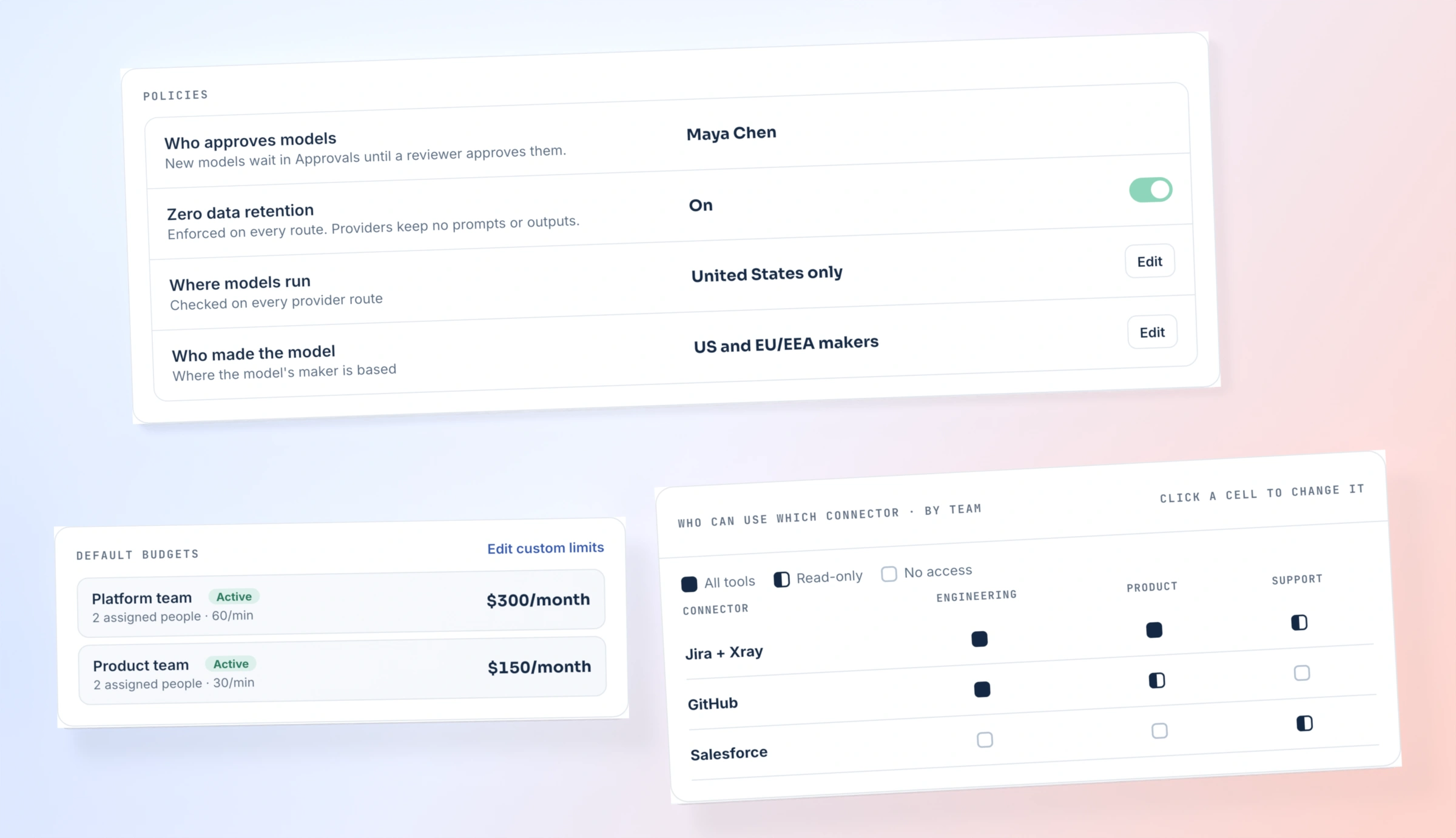

Set AI policy once. It applies in every tool your teams use.
Instead of configuring Claude, OpenAI, Cursor, Copilot, your MCP connectors and your agents one console at a time, you define the rules in Codiedev and they're enforced everywhere.
| Control | What you set |
|---|---|
| Model policy | Approved models, data retention, training opt-out, countries of origin, US or US + EU regions |
| Access by role | Which models, harnesses and MCP connectors each team, role or person can use |
| Budgets and limits | Monthly budgets and rate limits per team, person, agent and service key, with warnings before overages |
| MCP access | Connectors enabled per team, spend guards and blocked oversized calls |
| Guardrails | One rule set blocking secrets and destructive commands in every harness |
| Skill standards | Which skills are experimental, team standard or company standard |
| Identity | SCIM provisioning, teams, sub-teams and roles |
| Audit trail | A record of every policy change, access request and exception |
See AI usage and cost across everything, tied to the work that shipped.
Codiedev sits in the CLI, the LLM API and your repo, so every session and agent run is linked to the merge it produced. That turns a pile of invoices into one answer: what you're spending, where, and what it's buying you.
Spend and forecasting
- One spend view. AI usage and cost across every engineer, team, model, harness, MCP connector and agent.
- Cost per merge. By model, team and agent, tracked over time.
- Forecast before the bill. Monthly burn-down and projected month-end spend before any provider invoice arrives.
What’s working
- Models that merge cheapest. Which models ship code and which just burn tokens.
- Skills that ship. Which skills ran in the sessions that became merged PRs.
- Parallel agents. How many agents your top engineers run at once, and how the rest of the team compares.
- Same work, cheaper models. Suggested model switches priced on your real usage.
What needs attention
- Limits and blockers. Who hit a usage limit and what they were working on, so you can lift it.
- Session summaries. What each team is working on, in plain English. Your code is never stored.
- Agent inventory. Every agent your teams run: what it does, who built it and what it costs.
Data access: Everything here is available through the Codiedev API, so you can take it into your own BI tools.
New models reach your engineers in a week, not a procurement cycle.
Every week, admins get a short list of new models that passed your security policy, with their pricing, provider, region and data terms. Switch one on and it reaches every engineer and agent you choose, with budgets already attached. When a model retires, engineers are offered a replacement before anything breaks.
5 new models cleared your policy this week.
Pricing. Provider. Region. Data terms.
Switch one on. Reach the engineers and agents you choose.
Security and guardrails built to pass your review.
- Zero data retention on every approved model
- No training on your data
- Your code is never stored; we keep session summaries, not source
- US-only or US + EU processing regions
- Your keys, ours, or both, with no token markup
- SCIM provisioning, teams, sub-teams and roles
See your AI spend and policy in one place.
In a 20-minute demo we'll show you cost per merge, model policy and team adoption, using a setup like yours.